Hospital Visitor Experience Benchmark Report
How Modern Visitor Management Improves Safety, Flow & Patient Experience
Executive Summary
Visitor traffic is one of the most complex and under-managed components of hospital security. Every day, thousands of people enter healthcare facilities-family, vendors, caregivers, contractors, clinicians, sales reps, agency staff, law enforcement, and delivery personnel.
Yet most hospitals still rely on:
- Paper sign-in sheets
- Standalone badging kiosks
- Manual ID checks
- Unauthenticated badges
- Unmonitored visitor flow
- No integration with access control or video systems
A lack of modernization impacts safety, compliance, patient experience, and operational efficiency.
This benchmark report provides a data-driven overview of visitor patterns in healthcare and highlights how hospitals can improve safety and patient satisfaction through unified visitor management.
Visitor Traffic Is Growing Fast
Based on industry research from public sources (HIMSS, HFMA, Facility Executive, HID, and academic studies), visitor traffic in hospitals has been climbing year over year, driven by:
- Increased family presence in care
- More outpatient procedures
- More contractors and vendors
- Greater public access to ED and urgent care
- Expanded hospital campuses and ambulatory networks
Industry Benchmark Statistics
- Large hospitals average 8-15 visitors per patient per day (family, friends, caregivers, vendors).
- Peak visitor traffic occurs between 10 a.m.-1 p.m. and 5 p.m.-8 p.m.
- Over 60% of hospitals still use manual or semi-manual visitor check-in processes.
- 38% of facilities report no automated visitor identity verification.
- Visitor-related incidents (disturbance, unauthorized access, restricted zone entry) continue to rise yearly.
Risks Created by Outdated Visitor Systems
Hospitals that have not modernized visitor management face several systemic risks:
- Unauthorized Access Visitors accidentally or intentionally entering clinical zones (ICU, NICU, OR, behavioral health units).
- Escalation and Aggression High-stress interactions in ED waiting rooms and patient care areas.
- Infection Control Risks Visitors bypassing check-in during outbreaks or entering isolation-sensitive zones.
- Missing Identity Validation No way to verify identity or link visitors to specific patients or units.
- No Unit-Level Control Visitors may take the wrong elevator, move to the wrong floor, or enter restricted areas unnoticed.
- Compliance Failures Joint Commission and CMS expect visitor logs and access governance documentation.
What Modern Hospitals Are Doing Differently
Leading hospitals have modernized visitor management in several ways:
Pre-Registration and Role-Based Permissions Families, vendors, and contractors pre-register online or via email link.
Instant Identity Verification ID scanning validates identity within seconds.
Color-Coded Badges Badges clearly indicate visitor type, access limits, and time expiration.
Integration With Access Control Visitors receive time-bound, unit-bound access credentials.
Automated Visitor Routing BluSKY routes visitors through the correct elevator, floor, corridor, or waiting area.
Real-Time Analytics Executives can measure dwell time, throughput, peak hours, and unit-specific congestion.
AI-Assisted Monitoring BluB0X AI identifies:
- Loitering
- Movement into unauthorized areas
- Aggression or agitation
- Caregiver/visitor conflict
- Suspicious behavior patterns
This shifts visitor management from reactive monitoring to proactive protection.
Key Benchmark Metrics in Hospital Visitor Flow
- Average Visitor Check-In Time
- Industry average (manual): 2-7 minutes
- Modernized workflows: 20-40 seconds
- Unverified Visitor Percentage
- Manual systems: 25-40% lack proper ID verification
- Unified digital systems: \less than 5%
- Visitor-Related Security Incidents
- Standalone systems: higher risk of zone breaches
- Unified systems: ~30-40% fewer unauthorized access events
- Visitor Volume by Category
- Family: 55-60%
- Vendors / reps: 20-25%
- Contractors: 10-15%
- Delivery / transport: 5-10%
- Legal / law enforcement: \less than 5%
- Unit-Specific Hotspots
- Emergency Department
- Labor and Delivery
- Behavioral Health
- ICU
- Pediatrics
- Pharmacy
- Operating Rooms
Visitor Experience and Patient Satisfaction
Visitor experience has a measurable impact on patient satisfaction.
Positive visitor experience correlates strongly with:
- Improved HCAHPS “hospital environment” scores
- Better patient-reported sense of safety
- Lower anxiety and stress for families
- Better perceptions of care quality
- Improved staff satisfaction (less conflict, fewer escalations)
Common complaints about legacy systems include:
- Long lines
- Confusing processes
- Repeated ID checks
- Being misdirected to wrong floors or units
- Not feeling welcome
BluSKY improves the visitor experience by making check-in fast, clear, and secure.
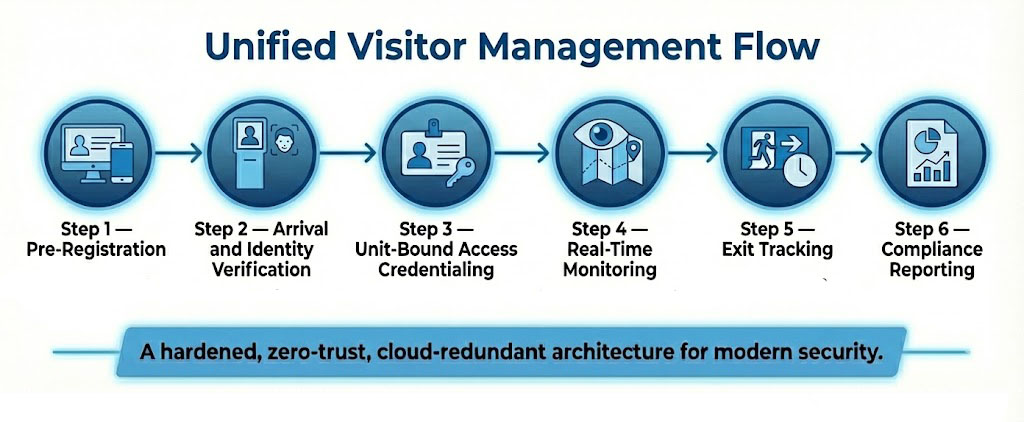
Step 1 - Pre-Registration Visitor receives a link to register before arrival: → Captures name, ID, relationship, patient/unit, visit type → Reduces lobby congestion
Step 2 - Arrival and Identity Verification Kiosk or staff-assisted check-in: → ID scanned → Visitor identity validated → Photo captured → Badge printed
Step 3 - Unit-Bound Access Credentialing Visitor receives access limited by:
- Time
- Unit
- Route
- Elevator access
Step 4 - Real-Time Monitoring BluSKY + BluB0X AI track visitor movement, including:
- Deviations from approved route
- Loitering
- Escalation patterns
- Attempted entry into restricted areas
Step 5 - Exit Tracking Visitor badge deactivates at end of visit or specific time window.
Step 6 - Compliance Reporting BluSKY automatically provides:
- Full visitor logs
- Photo history
- Access events
- Movement patterns
- Zone-entry violations
Benchmark Case Scenario (Composite)
A 450-bed metropolitan hospital modernized its visitor management using BluSKY.
Results (Composite)
- Visitor check-in time reduced from 3.5 minutes to 28 seconds
- 100% visitor identity verification
- 39% fewer unauthorized zone entries
- 52% reduction in ED waiting room incidents
- 80% decrease in manual reporting time
- Improved HCAHPS “Safety & Environment” perception scores
Qualitative Feedback “Families spend less time waiting, more time at the bedside.” “We catch problems before they escalate.” “Security is smoother, calmer, and much more defensible.”
Why BluSKY + BluB0X AI Are the New Standard
BluSKY transforms visitor management into a unified, intelligent, compliance-ready system.
BluSKY Advantages
- Unified access, video, alarms, and visitor management
- Full cloud architecture (no on-premises servers)
- Photo badges and identity verification
- Unit-specific access and elevator control
- Real-time monitoring and analytics
- Integration with HR, credentialing, and EHR systems
BluB0X AI Advantages
- Suspicious behavior detection
- Real-time escalation alerts
- Movement pattern clustering
- Visitor hot zone mapping
- Automated summaries for incidents and compliance
Together, they deliver unmatched control, safety, and patient-experience uplift.
Visitor Experience Improvement Scorecard
Rate your current visitor management on a scale of 1-5:
| Category | Score | Notes |
|---|---|---|
| Check-In Speed | ||
| Identity Verification | ||
| Visitor Routing Accuracy | ||
| Zone Protection | ||
| AI-Based Monitoring | ||
| ED Visitor Flow | ||
| Pediatric / NICU Controls | ||
| Contractor / Vendor Oversight | ||
| Compliance Documentation | ||
| System Integration Level |
Score Interpretation
- 40-50: Strong / Modern
- 25-40: Moderate Risk
- \less than 25: High Risk / Modernization Needed
Call to Action
Transform Visitor Safety and Experience Across Your Health System
BluSKY and BluB0X AI give hospitals a unified, fast, and compliant approach to visitor management-one that protects patients and staff while improving the overall experience.
Ready to explore a modern visitor management program? 👉 Schedule a Healthcare Visitor Management Demo