A Consultant-Focused Framework for Specifying Modern, Cloud-Native, Fully Unified Security Systems
Introduction: The End of Fragmented Security
Fragmented systems - access here, video there, elevators somewhere else - are no longer defensible in modern building environments. They create blind spots, increase risk, inflate costs, and make forensic work inefficient.
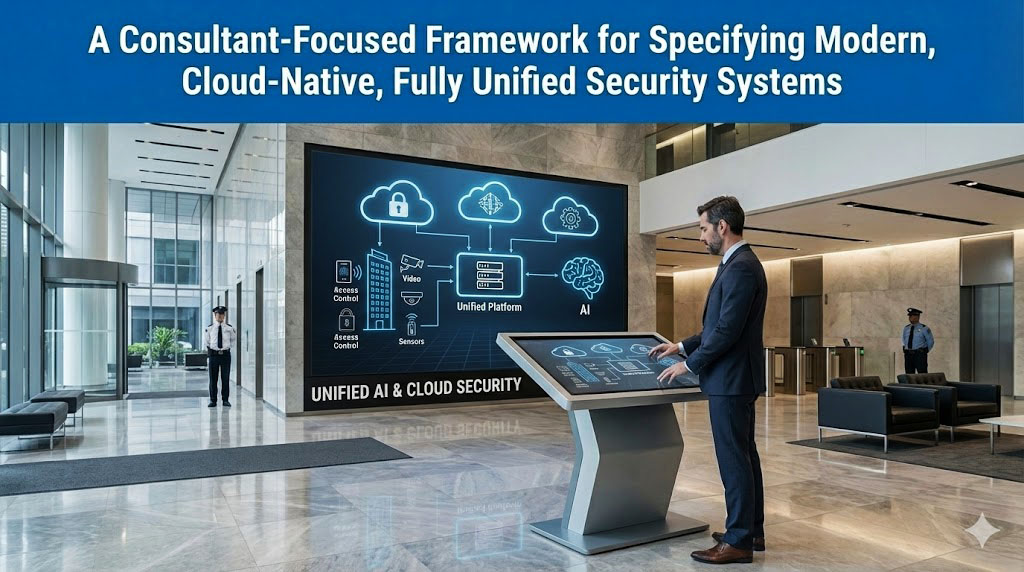
BluSKY replaces fragmentation with a single, cloud-native platform that unifies:
- Access control
- Video surveillance
- Alarms and intrusion
- Intercom and voice
- Elevator destination dispatch
- Visitor and vendor management
- Identity management (SCIM / SSO)
- Real-time AI analytics
- Logbooks and incident workflows
Every subsystem shares one identity model, one event stream, one UI, and one data layer. This is the architecture consultants can rely on for consistency, reliability, and future-proof design.
Unified Architecture Overview
Cloud-Native Core
BluSKY is 100% cloud-native, multi-tenant, redundant, and engineered for 99.99% uptime.
Advantages for consultants:
- No servers to specify, maintain, patch, or secure
- No hardware lifecycle risk
- Instant updates and feature rollouts
- Multi-site scalability with no redesign
- Multi-zone redundancy and auto-failover
- Zero Trust network posture
Unified Identity & Policy Engine
At the center of the system:
One identity → all systems
- Access
- Elevator rights
- Video association
- Intercom
- Visitor workflows
- AI models
- Risk scoring
- Logbook entries
Automated provisioning via:
- SCIM 2.0
- SSO (SAML, OIDC)
- HRIS connectors
Unified Event Layer
Instead of siloed logs and mismatched timestamps, BluSKY provides:
- A single timestamped event stream
- Synchronized across access, video, elevator, alarm, AI, and voice
- Fully searchable
- Fully correlated
- Fully exportable
Consultant benefits:
- Consistent auditing
- Reliable incident reconstruction
- Streamlined compliance reporting
Subsystem Mapping for a Fully Unified Design
Access Control
Key design elements:
- ARC hardware
- Mercury LP/EP series
- OSDP secure readers
- BluID mobile access
- HID Signo
- Person Reader (face + credential + QR)
- Full multi-factor support
Unified behaviors:
- Access decisions visible instantly across all systems
- Elevator authorization adjusts dynamically
- Automatic video bookmarks
- AI pipelines triggered by access activity
Video Surveillance
Delivered through:
- Milestone (via LVSM)
- ONVIF cameras
- Hybrid Cloud/Local recording
- BluB0X AI video pipelines
AI capabilities in the unified design:
- SceneIT - scene understanding, object catalogs
- RaceTrack - motion and trajectory analytics
- AutoLabel - semantic tagging
- AutoCameraROID - AI-driven ROIs
- AutoFloorROID - floorplan spatial mapping
- SummarEYES - timeline summarization
- RiskIt - predictive threat scoring
Video becomes contextual, correlated, and searchable - not isolated.
Intrusion & Alarm Monitoring
Unified into the BluSKY event stream:
- Sensor states
- Arming and disarming
- Automated rules
- Notification flows
- AI-assisted anomaly detection
Alarms automatically link to:
- Video
- Access events
- Elevator interactions
- Logbooks
- AI scoring
Elevator Destination Dispatch Integration
Full DDE integration with:
- Otis
- KONE
- TKE
- MCE/Nidec
- Mitsubishi
- Schindler
Unified behaviors:
- Person Reader triggers elevator calls
- Identity → policy → floor rights
- Visitor elevator rights auto-assigned
- Grouping, peak/off-peak optimization
- AI analysis of traffic patterns
Eliminates proprietary middleware, servers, and custom elevator integration specs.
Intercom & Voice
- SIP intercoms
- Cloud-managed master station
- Automatic identity linkage
- AI transcription
- Unified call logs
- Correlation with access and video
Voice becomes part of the unified security narrative.
Visitor & Contractor Management
Unified workflows include:
- Pre-registration
- QR credentials
- Visitor → access → elevator → video linkage
- Host notifications
- Cloud-based policy enforcement
- VMS API integrations
All visitor events feed automatically into security logs, AI pipelines, and incident timelines.
Unified Cybersecurity Requirements
Zero Trust
- No inbound firewall ports
- End-to-end encryption
- MFA for all admin functions
- Strict role-based permissions
- Multi-tenant isolation
- Continuous compliance controls
SOC 2 Type II
- BluSKY operates under a SOC 2 security program, reducing the need for consultants to specify custom IT hardening.
Simplified Network Design
- One IP connection per site (ARC or LVSM)
- VLAN segregation for camera networks
- No server patching
- No VPN requirements
The AI-Driven Unified System
AI as a Core Requirement
Consultants specifying BluSKY gain:
- Predictive risk scoring
- Automated event summaries
- Scene interpretation
- Identity-based analytics
- Cross-system reasoning
- Unified building logbook generation
This produces a living security system, not a passive dataset.
Intelligence Stack
BluB0X AI Pipelines:
- SummarEYES
- SceneIT
- RaceTrack
- RiskIt
- AutoLabel
- AutoID
- AutoCameraROID
- AutoFloorROID
- Blu Oracle
- Logbook AI
Every pipeline feeds into:
- The unified data lake
- The BluSKY Oracle
- Operator dashboards
- Automated responses and alerts
Consultant-Ready Specification Summary
**Specify:**BluSKY as the single cloud-native security management platform
- ARC/Mercury hardware for access
- LVSM for video unification
- Person Reader for identity verification
- SCIM/SSO for provisioning
- Elevator DDE integration
- AI pipelines for intelligence and automation
- • Trust + SOC 2 cybersecurity posture
- Unified event processing across all subsystems
Do NOT specify:
- Middleware
- Integration servers
- On-prem databases
- Separate systems for access/video/elevator/visitor/alarms
- Local backup routines
- Local analytics servers
- Manual sync workflows
These belong to legacy designs - not unified cloud-native architecture.
Conclusion
This Unified Security Design Framework gives consultants a prescriptive blueprint for delivering modern, enterprise-grade, cloud-native security architectures.
It aligns with:
- Modern building and CRE requirements
- IT and cybersecurity expectations
- Operational cost reduction
- AI-enhanced intelligence
- High-reliability cloud design
You now have a consultant-ready guide that clearly differentiates BluSKY from every legacy system in the industry.